
section-49dc337
Two main strategies will be used:
1. High-fidelity CFD modelling, which requires accurate sub-models for atomisation, chemistry, and turbulence–chemistry interaction. Within FFLECS, partners will advance these components: IC, KIT/ITS, and CNRS will improve atomisation models (including electromagnetic-field effects); UNINA will refine soot models for SAF and dual-fuel SAF/H₂ systems; UNIFI and UCAM will integrate these developments into advanced turbulent-combustion models (ATF, CMC), with attention to dual-fuel operation, NOx, and PM. Plasma-assisted combustion will also be incorporated. UCAM will extend the Doubly-Conditioned Moment Closure model for dual-fuel kinetics, while UNIFI will adapt LES-ATF methods for dual-fuel flame structures. IC will couple DNS/LES with Maxwell equations to predict combustion and spray behaviour in electric fields.
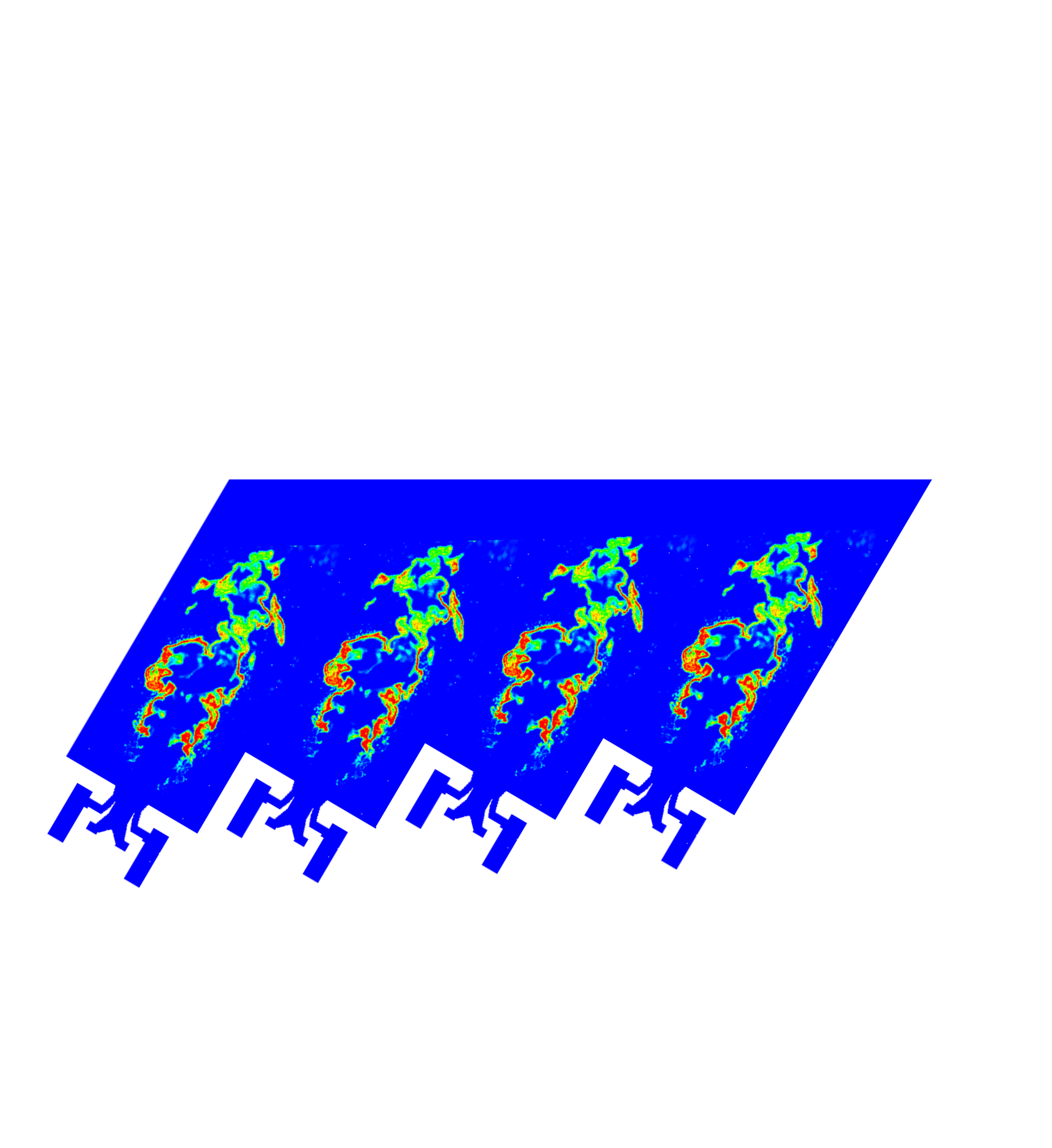 2. Low-order modelling, which captures key physics at much lower computational cost, will also be expanded. Reactor-network models will be enhanced using the Imperfectly Stirred Reactor Network method (UCAM) and UNIFI’s CRN experience. Zero-dimensional plasma-combustion and plasma-discharge models (UNILE) will integrate ZDPlasKin and CHEMKIN. Machine-learning tools—especially ANN-based control loops—will support real-time electric-field actuation for flame stabilisation, using sensors such as ion probes.
FFLECS will further develop advanced multi-physics numerical tools to study phenomena difficult to measure experimentally. CNRS will extend atomisation models based on curvature-distribution methods; KIT will apply Smoothed Particle Hydrodynamics to simulate electro-hydrodynamically enhanced liquid breakup; IC will use reactive molecular dynamics (ReaxFF, QTPIE, eFF/eReaxFF) to analyse electromagnetic effects during atomisation and combustion.
All modelling efforts will rely on improved chemical-kinetic schemes for dual-fuel (H₂ + SAF) combustion and updated PM/NOx formation pathways. UNINA contributes a detailed hydrocarbon-oxidation and PM-formation mechanism with sectional particle modelling that predicts particle mass, composition, and structure.